In the last ten years photography has taken a huge turn. It has developed from film emultion developed chemicalyto electronic capturing and being processed digitaly. The advantages of having a digital photography are huge. This piece of equipment allows you to have improved control, focusing and proportioning an image becomes much easier. Digital images have a lower grain effect, refered to as 'noise'. It alows you to change lens, to either marco lens, which alows you to shoot close up or lenses which give you a wide angle.
However, a down side to shooting digitaly is that your image is can easily be reproduced and is not as individual as an image shot by a manual SLR.
Digital photographs can be put on the internet imediatly, they can also be image corrected in Photoshop, should they need to be. Some people also use the internet to display their work, either to friends and family or as a means of making money.
PersonalyI find it difficult to choose wether I prefer shooting digitaly or manualy. Although manual photography takes much longer to do and is more difficult to image correct, I prefer the way that the work you produce is 'one of a kind'. However, efficiancy-wise, digital photography is much easier.
Sunday, 11 May 2008

Polaroid.

After the take over of digital technology, Polaroid had to adapt to the new technology.
The infamous American brand decided to stop making film, in an attempt to re-invent itself to comply with the new digital age.
Harvard University Drop-out Edwin Land started making polarized lenses for the science world in 1937. Creating his first instant camera in 1948.
Professional photographers would use the Polaroid camera to shoot images before they took the photograph on their film camera, this way they could check the lighting and exposures. However when the invention of digital cameras came along you could see the photograph instantly on the screen, therefore the Polaroid camera was no longer needed.
In 1991 Polaroid film sales were almost up to 3 billion, however, the production of one hour films in the mid 90's and then new age digital photography, Polaroid went bankrupt in 2001.
Although Polaroid are no longer making film themselves, the manufacturers think there is enough film in stock to last until 2009.
Whilst attempting to keep up with digital photography, Polaroid are now focusing on creating things which include; portable printers for mobile phone images and Polaroid branded digital cameras.
I think Polaroid was treated as a revolution in the photographic world, and although there is not as much need for it now, I hope they continue making it.
Mario Testino.

Mario Testino is one of the world’s greatest portrait photographers, well renowned for his photographs of famous women. On a recent trip to the National Portrait Gallery I was lucky enough to encounter some of his work up close. After having a good look around the Vanity Fair Exhibition I was caught immediately by one image in particular, Jennifer Aniston, after inspection I realised this image was shoot by Mario Testino, therefore I thought he would be a good person to add to my blog. Testino started out wanting to be a fashion photographer; he lived in an abandoned flat near Trafalgar Square, selling portfolios to wannabe models in order to earn enough money to live off. However knower days you would be much more likely to find him shooting people such as Angelina Jolie, Gwyneth Paltrow and Madonna. He was also called in to shoot Princess Diana before she died in 1997; this sequence of images is famous for being perhaps the warmest and most relaxed photographs ever.
Testino is currently on contract to Vogue and Vanity Fair, although many other magazines would kill to have him. Testino's photographs are known for variation, one image will be bright and vibrant (such as the image of Kate Moss) and another will be softly lit and elegant (such as his image of Jennifer Aniston) on looking at these photographs, they could quite easily be shot by two completely different photographers. Testino himself is said to prefer the more romantic way of shooting, the way he gets most of his images is by getting to know the sitter and becoming friends with them in order to get a much more relaxed shot. A quote from Testino "My photos are very simple. I believe the magic of photography is capturing the moment that doesn't exist a moment before or later"
Testino is specifically renowned for his photographs of women, but what about the men? As he started of being a fashion photographer he spent allot of time around women, he finds the sexiness of girls and the carefree and wildness of them exciting. One of his favourite girls would be Kate Moss, the portrait I refer to before is something a little different, people look at this image and see Kate Moss covered in really bad make-up, Testino said this image was to show that you could put anything on Kate Moss and she would still make it look good, which I think comes across clearly.
I think the reason Testinos images work so well is because he treats his sitters as people and not as models, he befriends them and gains their trust.
I would recommend going to see the Vanity Fair Exhibition at the National Portrait Gallery to anyone who can go, I gained allot of inspiration and found all the photographs very interesting.
Walker Evans.

Walker Evans is a renowned photographer, known for pushing the boundaries and influencing today’s photography artists.
His first impulse was to become a writer. However after travelling around, due to the fact that his parents had separated he realized writing was a passion of his, but not something he wanted to pursue, perhaps it was not challenging enough for him? He resented the American lifestyle, but ended up returning there anyway.
When he discovered a vest-pocket camera in 1928 he decided on a whim he would have a go at becoming a photographer, little did he realize he was about to change the history of photography....
Photography was not necessarily Evans' calling like writing, but it was something he thought he could do.
He began by challenging two other photographers who had also influenced the medium very much, Alfred Steiglitz and Edward Steichen. Evans' wanted to break out of the way that people saw photography; he dabbled in advertising, but was against the idea of perusing any of these conventional forms of photography.
Although Evans' had rejected the way that Stieglitz and Steichen had worked one persons advise stuck in his mind, "An artist should be everywhere felt, but no where seen. Further more art must rise above personal emotions and nervous susceptibilities. It is the time to endow it with pitiless method, with the exactness of physical science." Some of the major influences on Evans' were writers and painters. Evans' strived to be a perfectionist, but not for the public, for himself, he never thought himself good enough. Evans' approach to photography was for it to be nothing but the truth. He worked on capturing segments of time. Because of this distinguishable way of photographing it meant that Evans' photographs were easily recognisable from other photographers at the time.
After living in poverty and striving to live Evans' became part of the group known as "farm Security Administration". This group of photographers were renowned for making great work during the depression period, their work reflected images of how the poor people were living, and this allowed Evans' to do what he did best. True photography. Working with sunlight only, no manipulation of the images and mostly his photographs were based solely on luck.
Walker Evans changed the way we see photography now, and has been a huge influence on other photographers around now.
Semiotics.
Semiotics originates from the study of signs, these signs could be held in Photographs, Drawings or paintings, but also include words, sounds and body language.
The word "semiology" originates from the Greek word "Semion" meaning sign.
Ferdinand Saussure is renowned for developing semiotics, but to follow in his footsteps and further developed the theory are: American philosopher Charles Saunders and Charles William Morris. Then leading modern semiotic theorists: Roland Barthes, Algridas Greimas, Yuri Lotman and Julia Kristera.
Roland Barthes work and research meant that semiotics became a major approach to cultural studies in the late 1960's. For Saussure, who studied as a linguistic, semiology was 'a science which studied the roles of signs as part of social life.'
Semiotics looked at the 'reality' of an image, looking at how the meanings are made, and what connection they have to the real world.
However, even with the most basic images and semiotic terms there are several definitions, depending on how any one person perceives an image. The way Saussure looked at semiotics was different to that of Barthes, Saussure looked at the way language affected semiology, he believed language was the most important of all signs; however Barthes looked at the 'grammar' of narrative. Saussaure states "Linguistics is only one branch of this general science (of semiology)."
Victor Burgin however believes that there is no 'language' as such to photography, but more a system of codes, unlike in English, English (which relies upon the English language.) Burgin believes there is not such a simple connection with photography.
Semiotics allows us to interoperate the way the human eye views images and the meanings hidden in the image. Although the meaning in photographs may not always be obvious, it does not mean it is not there; semiotics is being able to understand where some of those meanings may be hidden and learning to read an image.
The word "semiology" originates from the Greek word "Semion" meaning sign.
Ferdinand Saussure is renowned for developing semiotics, but to follow in his footsteps and further developed the theory are: American philosopher Charles Saunders and Charles William Morris. Then leading modern semiotic theorists: Roland Barthes, Algridas Greimas, Yuri Lotman and Julia Kristera.
Roland Barthes work and research meant that semiotics became a major approach to cultural studies in the late 1960's. For Saussure, who studied as a linguistic, semiology was 'a science which studied the roles of signs as part of social life.'
Semiotics looked at the 'reality' of an image, looking at how the meanings are made, and what connection they have to the real world.
However, even with the most basic images and semiotic terms there are several definitions, depending on how any one person perceives an image. The way Saussure looked at semiotics was different to that of Barthes, Saussure looked at the way language affected semiology, he believed language was the most important of all signs; however Barthes looked at the 'grammar' of narrative. Saussaure states "Linguistics is only one branch of this general science (of semiology)."
Victor Burgin however believes that there is no 'language' as such to photography, but more a system of codes, unlike in English, English (which relies upon the English language.) Burgin believes there is not such a simple connection with photography.
Semiotics allows us to interoperate the way the human eye views images and the meanings hidden in the image. Although the meaning in photographs may not always be obvious, it does not mean it is not there; semiotics is being able to understand where some of those meanings may be hidden and learning to read an image.
The Print Space, Shoreditch.
The print space is based on Kingsland Road, near Old Street Tube Station. On arrival, I got a good welcoming feeling, the building was modern and the staff were friendly. The business was set up with the intention of allowing people to print good quality images at a lower price. The idea is that you do all the re-touching or work you want to your images and just pay for the paper and a small price for the ink, therefore you are not paying for any of the staff time, however they are on hand to help, should you need any.
They offer a wide Varity of different papers, ranging from metallic to matt paper. Downstairs they also have an exhibiting space, whilst we visited they had some impressive colour prints on the walls (probably also there to show what good quality their prints are)
you can also rent out Mac re-touching booths to colour correct your images. They have very high quality printers, which allow you to print images up to 80 x 60.
For photography students, this place is well worth a visit.
They offer a wide Varity of different papers, ranging from metallic to matt paper. Downstairs they also have an exhibiting space, whilst we visited they had some impressive colour prints on the walls (probably also there to show what good quality their prints are)
you can also rent out Mac re-touching booths to colour correct your images. They have very high quality printers, which allow you to print images up to 80 x 60.
For photography students, this place is well worth a visit.
The Bechers.

Bernd and Hilla Becher are renowned photographers, mainly because of their images of industrial buildings. They photograph buildings in black and white; this was done purposely, in order to allow the viewer to look at the building in a raw state. They carefully select buildings which have been similarly designed or designed in the same time era. On close inspection I realised the buildings all appear to be photographed against a blank background, but after researching I found out this was in fact done again on purpose. The Bechers carefully select over cast days to shoot their images, this again gives the final outcome a hard edge. For instance if these photographers were to be taken on a bright and sunny day would they still have the same feel to them? And if they were shot in colour, would that distract the viewer from the structure of the building itself? Because of these factors, all of the Bechers photographs are carefully set up, they would go and view the buildings first, to make sure there are no trees in the background, or anything that could distract from the building itself.
The final outcome consists of several images being displayed at the same time, in sets of six or four. If the images were displayed separately I don't think they would have as much of an impact.
Bernd Becher taught at the Fine Art Academy in Düsseldorf, some of his students consisted of: Thomas Struth, Candida Hofer and Andreas Gursky. The Bechers work has been displayed in several Galleries across the world, including the Tate.
Modernism.
Modernism is a movement which dates roughly from the 1860's to the 1970's. Modernism is a word used to describe the style of artwork produced during that time, although people concluded that any new art work produced during those 110 years was going to fall under the 'modernism' title, due to the fact that it was always something newer than the piece of art work before it.
However one question I ask is 'Is photography art?' Clarence White is renounced for being a master of fine art photography; he was part of the group formed by Alfred Stieglitz in 1920 who went by the name 'Photo-Secession'. This group took a fresh approach to photography, they made people look at it as an art form, and they recreated photographs out of the same objects found in paintings of that time. They took allot of their ideas and concepts from paintings or prints. They also used several different types of printing techniques, this combined with soft focus made the photographs look more like paintings or drawings.
However, Alfred Stieglitz moved on from what people referred to as 'pictorialist' images to a more detached and sharp approach to photographing. Therefore leaving this form of photography in the hands of Clarence White.
However one question I ask is 'Is photography art?' Clarence White is renounced for being a master of fine art photography; he was part of the group formed by Alfred Stieglitz in 1920 who went by the name 'Photo-Secession'. This group took a fresh approach to photography, they made people look at it as an art form, and they recreated photographs out of the same objects found in paintings of that time. They took allot of their ideas and concepts from paintings or prints. They also used several different types of printing techniques, this combined with soft focus made the photographs look more like paintings or drawings.
However, Alfred Stieglitz moved on from what people referred to as 'pictorialist' images to a more detached and sharp approach to photographing. Therefore leaving this form of photography in the hands of Clarence White.
Saturday, 10 May 2008
The Final One!!
As much as I have disliked doing this blog, I have also enjoyed it. At first I hated it.....But slowly I began to appreciate the fact that everyone can look at your work, and I actually enjoyed writing in my blog's. I enjoyed doing research for a variation of different subjects, and I have found out some pretty interesting things along the way. Some of the subjects I found harder than others, for instance the semiotics and psychological side of photography, but I enjoyed the challenge and once I got the hang of it, I really found it interesting.
I think this is a really good and motivating way of writing essays, because people can leave messages and comments on each others writing, it allows you to get feedback all the time, in order to improve your work. It also helps being able to view other peoples work and get an idea of different approaches.
Personally this way of writing I find much easier than writing an essay and I would be happy to do it again. (But I wouldn't make the mistake of not keeping a hard copy again!)
I think this is a really good and motivating way of writing essays, because people can leave messages and comments on each others writing, it allows you to get feedback all the time, in order to improve your work. It also helps being able to view other peoples work and get an idea of different approaches.
Personally this way of writing I find much easier than writing an essay and I would be happy to do it again. (But I wouldn't make the mistake of not keeping a hard copy again!)
Monday, 31 March 2008
The Punctum.
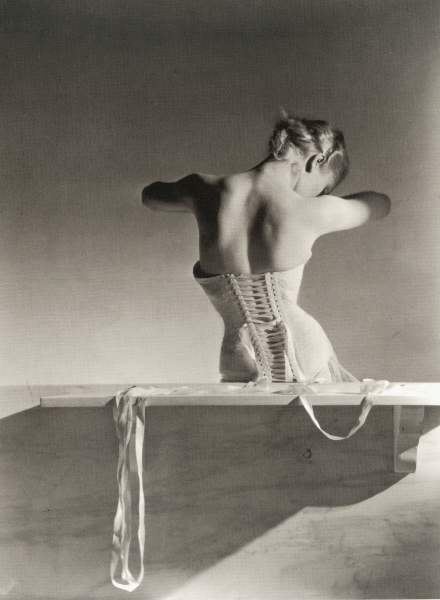
Having read Roland Barthes theorys on Studium and Punctum I selected the image "Mainboscher's Pink Satin Corset" by Horst P. to relate the theory of punctum to.
Three parts of the image which immediately stood out to me were: the ribbion, lacing up the back of the corset, the hair grip in the womans hair and the piece of wood supporting the underneath of the shlef.
The ribbion caught my attention immediately, my best friends sister used to walk around the house rubbing a ribbion against her nose, this was known as "Ribby" and was used as a sort of comfort toy to her, right up until she was 22!
The second part of the image which caught my attention was the womans hair grip. Hairgrips are things I use every day, I have one in now... therefor the punctum has an obvious connection.
The third part of the image is slightly more difficult for me to explain, as I can't quite make an immediate connection to it. However it is the wooden support underneath the shelf, one thing I did notice was the way that the ribbion is infact covering the other support, normally a shelf would have two supports, otherwise it would not be supported enough and fall down. Maybe the lack of symmetry is what made this stay in my mind? The only other thing I could think of is that my father would do alot of wood work when I was younger, perhaps he made something similar?
I have concluded that the punctum is the parts of the image which stands out to you, the viewer. Everyone views images differently, therefor one persons punctum might not be anothers. I have explained my connections to this image, wether they be an emotional connection or simply something I see everyday.
Friday, 21 March 2008
The Studium
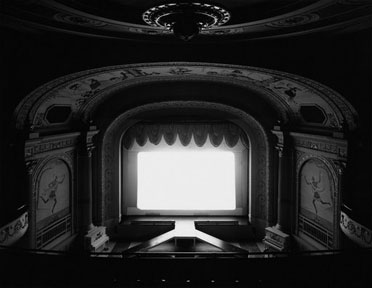
After having read the hand-outs from our Wednesday lectures, I now feel I have a greater understanding of Roland Barthes theory on Studium and Punctum.
From what I have researched the studium is questioning the image and looking at the cultuarl connections the image holds, by studying the image the veiwer would uncover different signs and symbols which would connect to parts of the image for various different meanings. It is also looking at the way we veiw the image and the actual meanings the contense of the image holds.
People percive different photographs in different ways and no one looks at the image the same way as the next person. Therefor perhaps I would see the signs and symbols in this image differently to the next person.
However, I am going to relate this theory to my chosen image called "Cabot Street Cinema" by Hiroshi Sugimoto. I chose this image because I think it is a very conceptual photograph, One obvious thing which stands out would have to be the bright, but blank white screen. White, is a colour usually associated with innocents and purity. After research this image, I found out that this is done on purpose, by using a ninty minute exposure.
However my eye is also particulary drawn towards the two white pianos either side of the screen and the main centre peice in the ceiling. Perhaps this could be because of the way the light falls across each of these artifacts?
This image was infact taken in a packed Cinema, yet you can not see any people and it has a very empty and deserted feeling to it. This, again was obviousley done on purpose, I would interperate this to mean that perhaps the image its self shows a very different feeling and mood to the cinema that day. But again on resaerch this was mearly done because Sugimoto himslef wanted to see what it would look like to shoot a whole movie in a single frame.... therefor perhaps there was no meaning behind his reasioning for doing this, quite simply, just experimentation?
Tuesday, 11 March 2008
Robert Frank's "My Fathers Coat"

I was 16, just started my BTEC Foundation at college in Guernsey when I was lucky enough to be taken on a class trip to London, whilst there we visited the Tate. After wondering around the Tate one thing in particular caught my attention, Robert Franks exhibition "Storylines". Although this was a while ago, I still believe this exhibition infulenced my choice to study photography now. So, for this I am going to look at Robert Franks "My Fathers Coat" this image consists of three images, known as a triptych. Each of the three images is of the same objects, only photographed from different angles, and different distances away. All of the photographs have strips of masking tape underneath them with the words "My Fathers Coat" Franks says he put these here to make the pictures seem like postcards, one thing that stands out about the text for me is the way it is written, all three are done in different colours and look asthough they have been written in a distressed state. The smudge mark on the text of the right hand image looks as though it could be from a tear-drop. If you have veiwed Franks work befor, you will notice the way that he uses text in his images is very different from a normal photographer. The image "Sick Of Goodbyes" shows Franks writing painted on a mirror, again in a very distressed way. Frank has also been known to scratch his negatives, something which most photographers would never consider doing, although, Frank is not most photographers, he strived to push the boundries of photography, also looking at the relationship between still and moving images.
Some distinguishable points in the image would be the coat itself, the medal on the coat and the aloe vera plant on the window cill.
The coat itself was recived from Robert Franks mother after his father died in 1976. He was told by his mother to wear the coat, however on returned to New York he hung the coat on a hook and did not wear it for many years. A quote from Frank "The writing under the photograph is like sending a postcard- the medal on the coat is an imaginary past; the plant is alive
and waiting and growing and I am getting old"
I feel this image comes across slightly depressing and sad, the way that the light falls across the photograph itself, that it is shot in black and white, also the description Frank gave of the image. I feel the use of angles and the way he has shot the seperate images, has portrayed the mood he was trying to get across very well.
Robert Frank is concidered to have revolutionised photography.
Subscribe to:
Comments (Atom)