Monday, 31 March 2008

The Punctum.


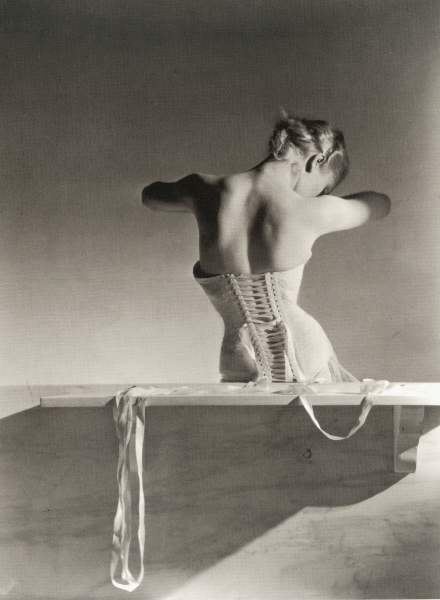
Having read Roland Barthes theorys on Studium and Punctum I selected the image "Mainboscher's Pink Satin Corset" by Horst P. to relate the theory of punctum to.
Three parts of the image which immediately stood out to me were: the ribbion, lacing up the back of the corset, the hair grip in the womans hair and the piece of wood supporting the underneath of the shlef.
The ribbion caught my attention immediately, my best friends sister used to walk around the house rubbing a ribbion against her nose, this was known as "Ribby" and was used as a sort of comfort toy to her, right up until she was 22!
The second part of the image which caught my attention was the womans hair grip. Hairgrips are things I use every day, I have one in now... therefor the punctum has an obvious connection.
The third part of the image is slightly more difficult for me to explain, as I can't quite make an immediate connection to it. However it is the wooden support underneath the shelf, one thing I did notice was the way that the ribbion is infact covering the other support, normally a shelf would have two supports, otherwise it would not be supported enough and fall down. Maybe the lack of symmetry is what made this stay in my mind? The only other thing I could think of is that my father would do alot of wood work when I was younger, perhaps he made something similar?
I have concluded that the punctum is the parts of the image which stands out to you, the viewer. Everyone views images differently, therefor one persons punctum might not be anothers. I have explained my connections to this image, wether they be an emotional connection or simply something I see everyday.

Friday, 21 March 2008

The Studium


After having read the hand-outs from our Wednesday lectures, I now feel I have a greater understanding of Roland Barthes theory on Studium and Punctum.
From what I have researched the studium is questioning the image and looking at the cultuarl connections the image holds, by studying the image the veiwer would uncover different signs and symbols which would connect to parts of the image for various different meanings. It is also looking at the way we veiw the image and the actual meanings the contense of the image holds.
People percive different photographs in different ways and no one looks at the image the same way as the next person. Therefor perhaps I would see the signs and symbols in this image differently to the next person.
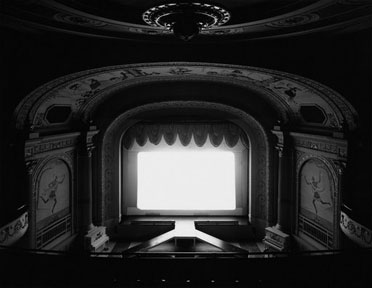
However, I am going to relate this theory to my chosen image called "Cabot Street Cinema" by Hiroshi Sugimoto. I chose this image because I think it is a very conceptual photograph, One obvious thing which stands out would have to be the bright, but blank white screen. White, is a colour usually associated with innocents and purity. After research this image, I found out that this is done on purpose, by using a ninty minute exposure.
However my eye is also particulary drawn towards the two white pianos either side of the screen and the main centre peice in the ceiling. Perhaps this could be because of the way the light falls across each of these artifacts?
This image was infact taken in a packed Cinema, yet you can not see any people and it has a very empty and deserted feeling to it. This, again was obviousley done on purpose, I would interperate this to mean that perhaps the image its self shows a very different feeling and mood to the cinema that day. But again on resaerch this was mearly done because Sugimoto himslef wanted to see what it would look like to shoot a whole movie in a single frame.... therefor perhaps there was no meaning behind his reasioning for doing this, quite simply, just experimentation?

Tuesday, 11 March 2008

Robert Frank's "My Fathers Coat"


I was 16, just started my BTEC Foundation at college in Guernsey when I was lucky enough to be taken on a class trip to London, whilst there we visited the Tate. After wondering around the Tate one thing in particular caught my attention, Robert Franks exhibition "Storylines". Although this was a while ago, I still believe this exhibition infulenced my choice to study photography now. So, for this I am going to look at Robert Franks "My Fathers Coat" this image consists of three images, known as a triptych. Each of the three images is of the same objects, only photographed from different angles, and different distances away. All of the photographs have strips of masking tape underneath them with the words "My Fathers Coat" Franks says he put these here to make the pictures seem like postcards, one thing that stands out about the text for me is the way it is written, all three are done in different colours and look asthough they have been written in a distressed state. The smudge mark on the text of the right hand image looks as though it could be from a tear-drop. If you have veiwed Franks work befor, you will notice the way that he uses text in his images is very different from a normal photographer. The image "Sick Of Goodbyes" shows Franks writing painted on a mirror, again in a very distressed way. Frank has also been known to scratch his negatives, something which most photographers would never consider doing, although, Frank is not most photographers, he strived to push the boundries of photography, also looking at the relationship between still and moving images.
Some distinguishable points in the image would be the coat itself, the medal on the coat and the aloe vera plant on the window cill.
The coat itself was recived from Robert Franks mother after his father died in 1976. He was told by his mother to wear the coat, however on returned to New York he hung the coat on a hook and did not wear it for many years. A quote from Frank "The writing under the photograph is like sending a postcard- the medal on the coat is an imaginary past; the plant is alive
and waiting and growing and I am getting old"
I feel this image comes across slightly depressing and sad, the way that the light falls across the photograph itself, that it is shot in black and white, also the description Frank gave of the image. I feel the use of angles and the way he has shot the seperate images, has portrayed the mood he was trying to get across very well.
Robert Frank is concidered to have revolutionised photography.